
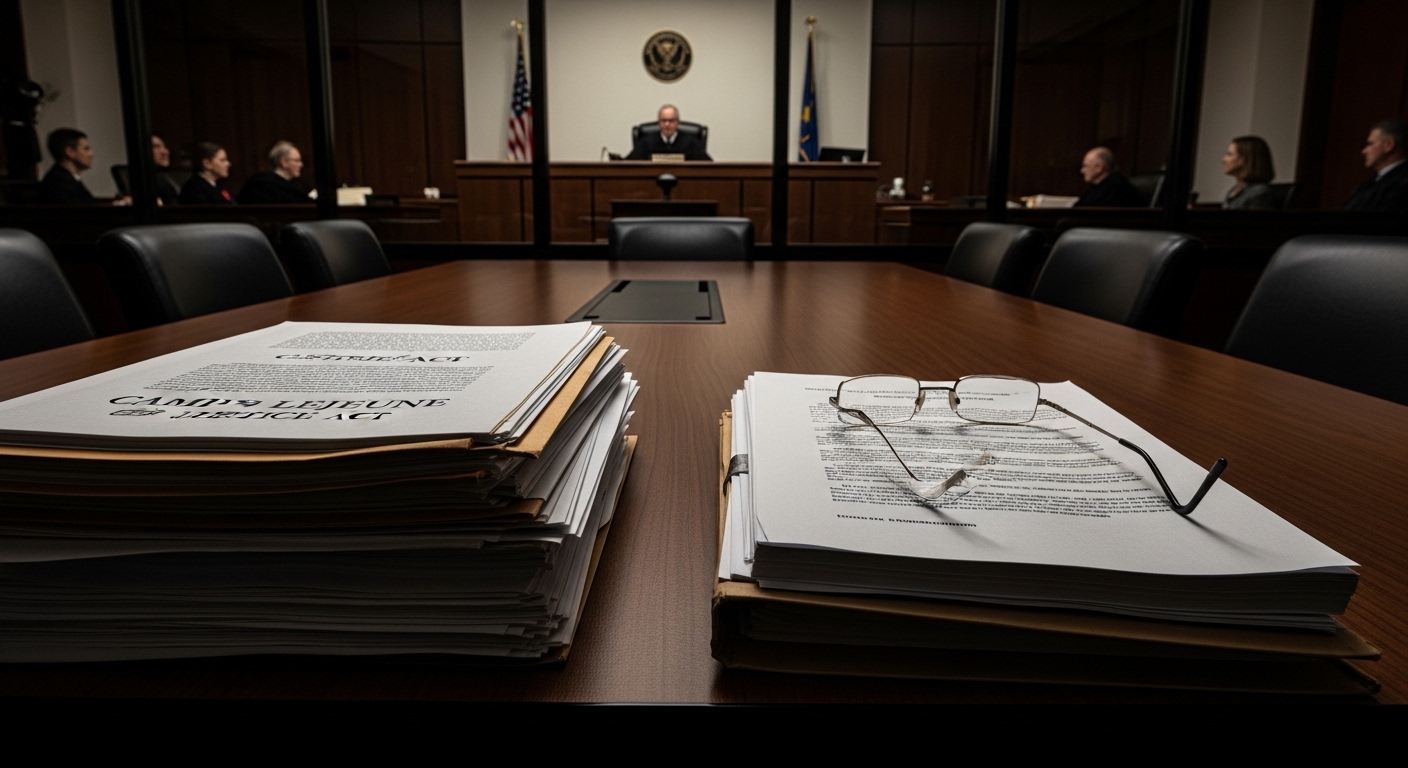
The Camp Lejeune Lawsuit continues to represent one of the largest mass tort actions against the federal government in recent history. As of April 2026, more than 400,000 administrative claims have been filed with the Department of the Navy, and approximately 3,700 individual lawsuits are pending in the U.S. District Court for the Eastern District of North Carolina. Recent developments include accelerated settlement approvals under the Elective Option program and ongoing pretrial disputes over causation standards, expert testimony, and trial scheduling.
This article provides a factual overview of the current status of the Camp Lejeune Lawsuit, grounded in official court records, Department of Justice announcements, and established legal procedures under the Camp Lejeune Justice Act.
Background
Between 1953 and 1987, drinking water at Marine Corps Base Camp Lejeune in North Carolina was contaminated with volatile organic compounds, including trichloroethylene (TCE), perchloroethylene (PCE), benzene, and vinyl chloride. These contaminants originated from on-base industrial activities, leaking underground storage tanks, and off-base dry-cleaning operations. Two of the base’s eight water supply systems were affected, with a third intermittently impacted during shortages.
Federal studies by the Agency for Toxic Substances and Disease Registry (ATSDR) have documented associations between exposure to these chemicals and increased risks of certain cancers (such as leukemia, non-Hodgkin lymphoma, kidney cancer, and bladder cancer), as well as other serious conditions including Parkinson’s disease and adverse birth outcomes. The Department of Veterans Affairs recognizes presumptive service connections for many of these conditions among eligible veterans. These documented health effects form the factual foundation for claims under the Camp Lejeune Lawsuit.
Prior to 2022, most affected individuals were barred from pursuing tort claims against the United States due to the application of North Carolina’s statute of repose in Federal Tort Claims Act cases. This procedural barrier prevented merits-based adjudication for decades.
The Camp Lejeune Justice Act: Legislative Framework
Congress addressed these barriers through Section 804 of the Honoring our Promise to Address Comprehensive Toxics (PACT) Act of 2022, Public Law 117-168, commonly known as the Camp Lejeune Justice Act of 2022. Signed into law on August 10, 2022, the Act waives sovereign immunity for claims arising from the contaminated water exposure and establishes a two-year administrative filing window that closed on August 10, 2024.
The statute permits individuals who lived, worked, or were otherwise present at Camp Lejeune for at least 30 days during the relevant period—and who developed a qualifying injury—to seek compensation. It explicitly provides that the “as likely as not” causation standard applies for certain presumptive conditions, overriding stricter common-law requirements in some interpretations. The Act designates the U.S. District Court for the Eastern District of North Carolina as the exclusive venue for any civil actions filed after administrative denial or inaction.
This legislative response reflects Congress’s intent to provide a meaningful remedy where prior legal doctrines had left victims without recourse.
The Administrative Claims Process and Elective Option Program
Claimants must first submit an administrative claim to the Department of the Navy’s Camp Lejeune Claims Unit. The filing deadline has passed, and no new claims are being accepted. The Navy continues to process the more than 409,000 non-duplicate claims filed by the deadline, requiring documentation of presence at the base and a qualifying medical diagnosis.
To expedite resolution, the Department of the Navy and Department of Justice established the Elective Option (EO) program in 2023. This voluntary settlement framework offers fixed compensation ranges—generally between $100,000 and $550,000—for claimants meeting specific criteria related to diagnosis and exposure duration, without requiring full litigation.
Recent settlement activity has accelerated. On March 10, 2026, the Department of Justice announced approval of 649 new EO offers totaling $175 million over the prior three weeks. Since January 20, 2025, more than $421 million has been paid under the EO program. Overall, since the EO’s inception in 2023, 2,531 settlement offers have been approved for approximately $708 million.
Associate Attorney General Stanley Woodward stated that the Department has “reprioritized approving settlements for Camp Lejeune victims and families” and will continue weekly approvals. Despite this progress, attorneys representing claimants note that only a small percentage of the total claims—roughly 12 percent—have reached EO resolution, and many remain pending documentation review.
Status of Federal Court Litigation
For claimants whose administrative claims are denied or remain unresolved after six months, the Camp Lejeune Justice Act authorizes filing suit in federal court. As of early 2026, more than 3,700 such lawsuits had been filed in the Eastern District of North Carolina, with a small number dismissed on procedural grounds. The cases are assigned among multiple judges and coordinated under case management orders issued by the court.
The court has appointed a Plaintiffs’ Leadership Group to coordinate proceedings and maintain a public resource website (camplejeunecourtinfo.com) for pro se litigants and others. Multiple Case Management Orders govern discovery, expert disclosures, and other pretrial matters. Settlement masters and a magistrate judge have been appointed to facilitate global settlement discussions, though no comprehensive matrix-style agreement has been finalized.
Bellwether trials—intended to provide representative outcomes for broader resolution—are anticipated to begin in 2026. Twenty-five cases were selected for mediation in 2025; most did not settle, positioning them for trial. Pretrial motions focus on expert admissibility under Federal Rule of Evidence 702, specific causation, and potential offsets for benefits already received through VA or Medicare programs.
Recent Court Developments (March–April 2026)
Key procedural rulings continue to shape the litigation:
- On March 18, 2026, a federal judge struck certain expert reports submitted by the Department of Justice, narrowing the scope of government defense evidence on scientific issues.
- On April 1, 2026, the Department of Justice filed a motion seeking an early ruling on its “but-for” causation argument, which would impose a stricter standard than the “as likely as not” language in the Camp Lejeune Justice Act. Plaintiffs oppose this motion, arguing it should be resolved through the bellwether trial process rather than dispositive pretrial motions.
These disputes reflect ongoing tension between the government’s position on liability limits and plaintiffs’ interpretation of congressional intent. Separate legislative proposals introduced in 2025, such as the Ensuring Justice for Camp Lejeune Victims Act, seek technical corrections to clarify jury-trial rights and causation standards, though their status remains pending in the 119th Congress.
What This Means for Affected Individuals
The Camp Lejeune Lawsuit provides a pathway to compensation for harms that were previously un-addressable under existing law. Veterans, family members, and civilians who meet the statutory criteria may pursue relief through either the Elective Option settlements or full litigation. Those with qualifying conditions who have not yet submitted supporting documentation are encouraged to do so promptly through the Navy’s claims portal to facilitate review.
However, the process remains complex. Administrative claims require detailed medical and service records, and court cases involve rigorous expert testimony and discovery. Outcomes will continue to depend on individualized evidence of exposure duration, specific diagnosis, and causation.
You May Also Like: Roots Meijer Trademark Dispute: Full Legal Breakdown
Disclaimer:
This article is for informational purposes only and does not constitute legal advice. Individuals seeking compensation should consult qualified counsel experienced in Camp Lejeune Justice Act matters. The status of any individual claim depends on specific facts and applicable law. For official updates, refer to the U.S. Department of Justice, the Department of the Navy’s Camp Lejeune Claims Unit, or the Eastern District of North Carolina’s dedicated litigation page.
The Camp Lejeune Lawsuit underscores the government’s evolving accountability for environmental exposures affecting military personnel and their families. As pretrial proceedings advance toward bellwether trials in 2026, further clarity on settlement frameworks and compensation standards is expected in the coming months.