
On December 18, 2025, a federal jury in the U.S. District Court for the Eastern District of Wisconsin convicted Milwaukee County Circuit Judge Hannah C. Dugan of felony obstruction of a federal administrative proceeding under 18 U.S.C. § 1505. The jury acquitted her on a related misdemeanor charge of concealing a person from arrest under 18 U.S.C. § 1071.
The verdict followed a four-day trial stemming from an April 18, 2025, incident at the Milwaukee County Courthouse. Federal prosecutors alleged that Dugan, while presiding over a state court hearing, took steps that impeded U.S. Immigration and Customs Enforcement (ICE) agents from executing an administrative arrest warrant on a defendant appearing before her.
This case, prosecuted by the U.S. Department of Justice’s Eastern District of Wisconsin office, has drawn national attention because it involves the intersection of state judicial authority and federal immigration enforcement. It highlights procedural questions about courthouse operations, the scope of federal obstruction statutes, and the limits of judicial conduct when federal agents are present in a state facility.
Background of the Incident
Eduardo Flores-Ruiz, a Mexican national subject to a final order of removal, appeared in Dugan’s courtroom that day on state misdemeanor domestic-battery charges. ICE agents had an administrative warrant authorizing his arrest for purposes of removal proceedings conducted by the Department of Homeland Security (DHS).
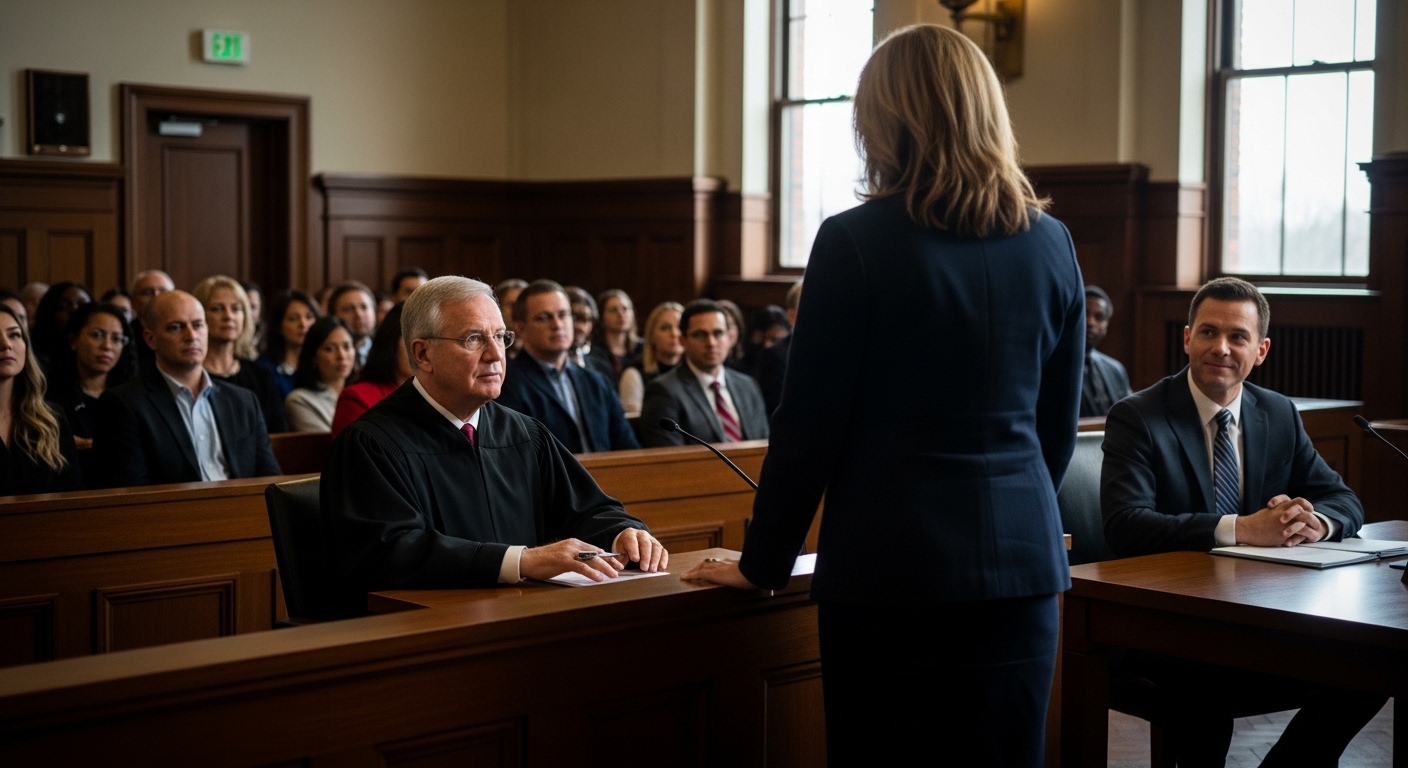
According to evidence presented at trial; including courtroom audio recordings, security video, and witness testimony; ICE agents arrived in the public hallway outside Dugan’s courtroom. Dugan’s clerk informed her of their presence. Dugan then left the bench, confronted the agents in the hallway, and directed them to speak with the chief judge. She returned to the courtroom, placed the hearing off the record, and instructed Flores-Ruiz and his attorney to exit through a private side door and stairs.
Flores-Ruiz and his attorney ultimately left through the public hallway. Agents pursued and arrested him outside the courthouse after a brief foot chase. He was later deported.
Court records and trial exhibits showed prior discussions among Milwaukee County judges, including Dugan, about draft protocols for handling ICE activity in the courthouse. Those discussions reflected growing concern over immigration enforcement operations inside state facilities.
The Charges: Legal Framework and Elements
Federal prosecutors charged Dugan with two counts in a May 2025 indictment (Case No. 2:25-cr-00089, before U.S. District Judge Lynn Adelman).
Count One – Concealing a Person from Arrest (18 U.S.C. § 1071) This misdemeanor statute prohibits knowingly harboring or concealing any person for whom a federal warrant or process has been issued, with intent to prevent that person’s discovery and arrest. To convict, the government had to prove beyond a reasonable doubt that: (1) a federal warrant or process existed; (2) the defendant knew of it; (3) the defendant actually harbored or concealed the individual; and (4) the defendant acted with intent to prevent discovery or arrest.
Count Two – Obstruction of Proceedings Before a Federal Agency (18 U.S.C. § 1505) This felony statute makes it unlawful to “corruptly” endeavor to influence, obstruct, or impede the due and proper administration of the law under which any pending proceeding is being had before any department or agency of the United States. “Corruptly” is defined in 18 U.S.C. § 1515 as acting with an improper purpose, including making false or misleading statements or withholding information.
In this case, prosecutors argued the “pending proceeding” was ICE’s administrative arrest and removal process under DHS authority. They contended Dugan’s actions; confronting agents, directing them away, and facilitating an alternate exit; were affirmative steps taken with corrupt intent to impede that process.
Dugan’s defense team argued that her conduct fell within lawful judicial authority to manage her courtroom, that she lacked specific knowledge of the warrant’s details, and that no “pending proceeding” existed under § 1505 because the administrative warrant did not qualify as such. They also raised constitutional and common-law arguments concerning judicial immunity and privileges against civil arrests in courthouses.
Trial Proceedings and Evidence
The trial, which began on December 15, 2025, featured testimony from ICE agents, courthouse staff, the chief judge, and defense witnesses. Jurors heard never-before-released audio from inside the courtroom capturing Dugan’s instructions, including references to taking stairs and exiting privately. Security footage showed the sequence of events in the hallway.
After six hours of deliberation, the jury returned a split verdict: guilty on the felony obstruction count and not guilty on the misdemeanor concealment count. This outcome suggested jurors found sufficient evidence of corrupt obstruction of the federal proceeding but were not convinced beyond a reasonable doubt that Dugan’s actions met all elements of concealment with intent to hide the defendant from arrest.
Aftermath and Current Status
Dugan resigned from the bench in early January 2026. Under Wisconsin’s constitution, a felony conviction renders a judge ineligible to hold office.
On January 30, 2026, Dugan’s attorneys filed post-trial motions seeking judgment of acquittal or a new trial under Federal Rule of Criminal Procedure 33. They argued, among other points, that the jury instructions were flawed, that the government failed to prove a nexus to a qualifying “pending proceeding,” and that her actions were protected judicial acts. Federal prosecutors filed their opposition on February 20, 2026, asserting that many arguments were waived or had already been rejected by the court.
As of March 31, 2026, no sentencing date has been set. Dugan faces a statutory maximum of five years in prison and a fine of up to $250,000 on the felony count, though federal sentencing guidelines and judicial discretion will determine the actual penalty. Appeals are expected following sentencing.
Legal and Practical Significance
This case is notable as one of the first federal prosecutions of a sitting state judge for allegedly obstructing immigration enforcement inside a courthouse. It illustrates the tension between:
- Federal authority to enforce immigration laws, including administrative arrests in public areas of state facilities.
- State judicial independence in managing court proceedings and protecting parties’ access to justice.
Courthouse arrests by federal agents have long been a point of debate. Supporters argue they are efficient and minimize flight risk. Critics contend they can deter immigrants from participating in state court matters, undermining public safety and due process in unrelated cases.
For legal professionals and court administrators, the verdict underscores the importance of clear protocols for interactions between state courts and federal agencies. Many jurisdictions have adopted or are considering written policies on ICE presence, notification requirements, and limits on courtroom access.
The split verdict also demonstrates how juries can parse closely related charges with overlapping facts. The not-guilty finding on concealment while convicting on obstruction suggests the jury viewed Dugan’s conduct as impeding a federal process without crossing into active concealment.
Broader Context for Practitioners and the Public
Judges, court staff, and attorneys should note that federal obstruction statutes like § 1505 apply broadly to agency proceedings and do not require physical force or direct lying; affirmative acts taken with improper purpose can suffice. At the same time, the defense’s post-trial arguments highlight ongoing legal questions about whether post-removal administrative warrants qualify as “pending proceedings” under § 1505, an issue being litigated in other circuits.
This prosecution does not alter core principles of judicial immunity, which generally protects judges from civil liability for judicial acts but does not shield against criminal charges alleging corrupt intent to obstruct federal law.
Disclaimer:
This article is for informational purposes only and does not constitute legal advice. Readers should consult qualified counsel for advice specific to their circumstances. Court records, including the indictment, motions, and trial transcripts, are publicly available through the U.S. District Court for the Eastern District of Wisconsin (Case No. 2:25-cr-00089).
As sentencing and potential appeals proceed, this case will continue to shape discussions about federal-state courthouse cooperation, judicial ethics, and immigration enforcement priorities. We will provide updates as new developments occur.